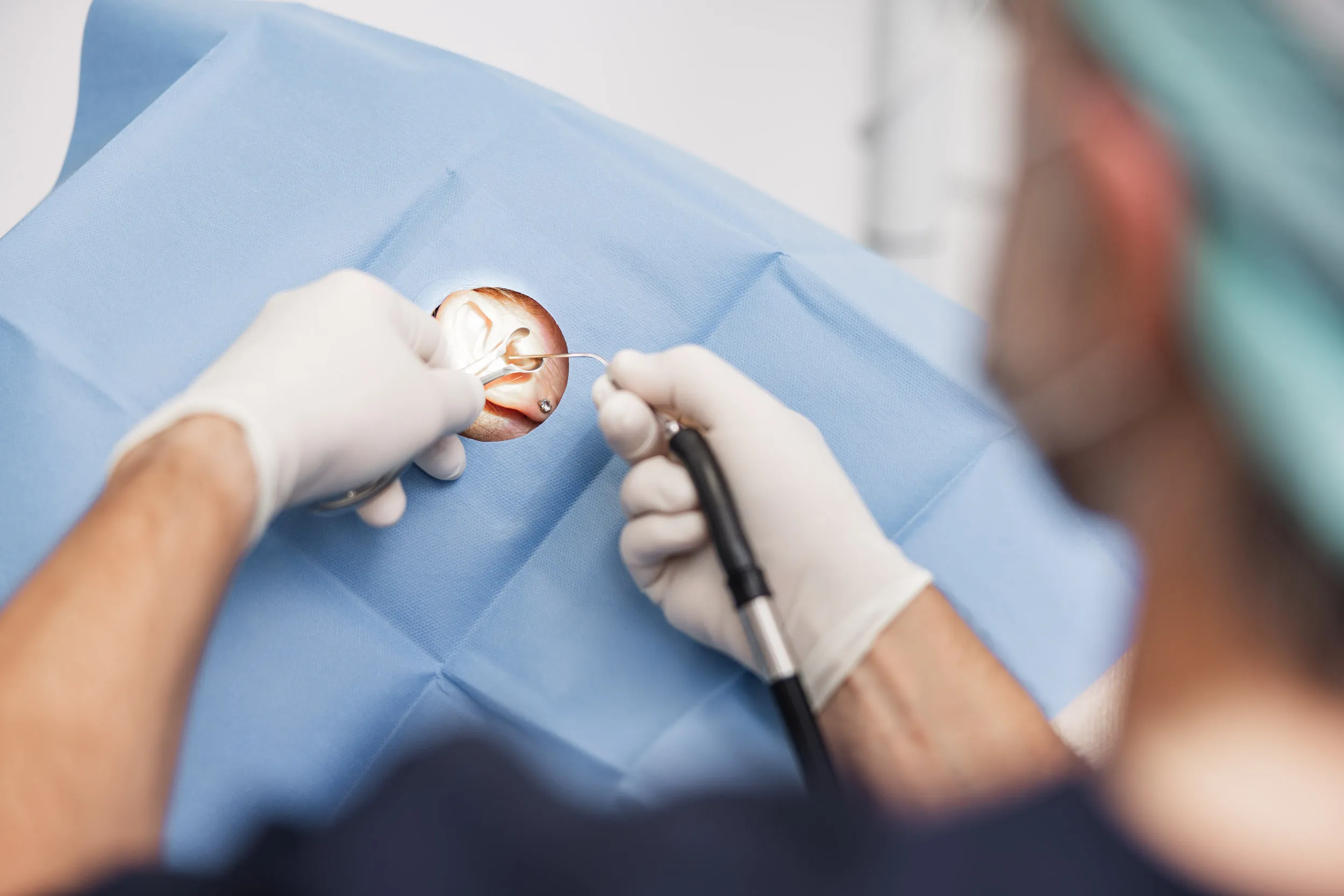
Ears
Diseases of the ear affect the outer ear – the auricle with ear canal and eardrum – the middle and the inner ear. The symptoms range from pain and discharge through hearing loss and ear noises to dizziness. A specialist examination with ear microscopy and a hearing test is usually the first step in the assessment.
Hearing loss
Hearing loss is one of the most common health problems and particularly affects older adults. Age-related hearing decline (presbycusis) usually begins gradually and initially affects the high frequencies, which makes understanding speech in noisy environments difficult.
A fundamental distinction is made between conductive hearing loss (a problem in the outer or middle ear, e.g. earwax, middle ear effusion, otosclerosis) and sensorineural hearing loss (a problem in the inner ear or auditory nerve). Diagnostics include ear microscopy, tuning fork tests, pure-tone audiometry and speech audiometry.
Depending on the cause, conservative measures (hearing aid provision), drug therapies or surgical procedures (e.g. grommet insertion, tympanoplasty, stapedoplasty) are available. Early assessment and provision are important, as untreated hearing loss can lead to social withdrawal and cognitive decline.
Ear noise (tinnitus)
Tinnitus refers to the perception of noise in the ear or head without an external sound source. The noises are described as whistling, rushing, humming, ringing or buzzing and can occur on one or both sides.
Tinnitus is often an expression of an inner ear disorder and frequently occurs together with hearing loss. Possible causes are noise damage, sudden hearing loss, Menière’s disease, circulatory disorders, middle ear diseases, medication side effects or stress. In rare cases, an acoustic neuroma may also be the underlying cause.
The assessment includes a detailed ear examination, a hearing test and, if necessary, imaging procedures (MRI). Treatment depends on the cause and may include drug treatment, hearing aid provision, tinnitus retraining therapy or cognitive behavioural therapy. A specialist assessment is recommended, especially for sudden or one-sided tinnitus.
Sudden hearing loss
Sudden hearing loss is an abrupt, usually one-sided loss of hearing with no identifiable external cause. It occurs suddenly – often within seconds or minutes – and can be accompanied by ear noises (tinnitus), a feeling of pressure in the ear and occasionally dizziness.
The exact cause cannot be clearly determined in many cases. Circulatory disorders of the inner ear, viral infections, autoimmune processes and stress are discussed as possible triggers.
The spontaneous recovery rate is about 40%. With early treatment – usually with systemic or intratympanic corticosteroids – the recovery rate can be increased to about 60%. Prompt specialist consultation and rapid initiation of treatment are therefore strongly recommended.
Dizziness and Menière’s disease
Dizziness is a very common symptom and can have a wide variety of causes. The balance organ in the inner ear plays a major role in controlling balance. A distinction is made between systematic dizziness (rotary vertigo, swaying vertigo) and unsystematic dizziness (light-headedness, unsteadiness).
Benign positional vertigo (BPPV) is the most common form and is caused by displaced otoliths (ear crystals) in the semicircular canals. It can usually be treated successfully with targeted positioning manoeuvres (e.g. Epley manoeuvre) within a few sessions.
Menière’s disease is characterised by recurrent attacks of rotary vertigo (minutes to hours), hearing loss, tinnitus and a feeling of pressure in the affected ear. The disease is caused by excess pressure of the inner ear fluid (endolymphatic hydrops).
Treatment includes drug measures (betahistine, diuretics), dietary recommendations (low-salt diet) and, in severe cases, surgical options such as endolymphatic sac drainage or intratympanic gentamicin therapy.
Middle ear infections (acute and chronic)
Acute middle ear infection (otitis media acuta) is particularly common in childhood and manifests as sudden earache, fever and occasionally ear discharge. It usually develops through an ascending infection via the Eustachian tube during a respiratory infection.
In children, repeated middle ear infections can lead to chronic middle ear effusion, which impairs hearing and can delay speech development. In adults, a persistent effusion can remain after infections.
Chronic middle ear infection (otitis media chronica) can manifest as mucosal suppuration with a central eardrum perforation or as bone suppuration (cholesteatoma) with a marginal perforation. Cholesteatoma requires surgical treatment.
Therapeutic options range from conservative treatment (decongestant nasal drops, antibiotics) through incision of the eardrum (paracentesis) with or without insertion of a grommet to tympanoplasty and mastoidectomy for chronic forms.
Cochlear implant (CI)
The cochlear implant is an electronic hearing aid for patients with severe inner ear hearing loss or deafness in whom conventional hearing aids can no longer achieve sufficient hearing improvement.
The system consists of an externally worn speech processor with a microphone and a surgically inserted implant with an electrode array in the cochlea. It converts sound signals into electrical impulses that directly stimulate the auditory nerve and thus create a hearing sensation.
The implantation is performed under general anaesthesia. The operation is followed by an intensive rehabilitation phase with regular adjustments of the speech processor and hearing training. The results are very encouraging in most patients, especially when the provision is made early.
As former medical director of the Cochlear Implant Centre at the Universitätsspital Basel, Dr. Zehnder has extensive experience in CI provision and will be happy to advise you on the options.
Hearing aids, BAHA and active middle ear implants
For hearing loss that cannot be treated surgically, various device-based options are available:
Conventional hearing aids amplify sound and are the first choice for most forms of hearing loss. Modern digital hearing aids offer excellent sound quality and numerous additional functions.
BAHA (Bone Anchored Hearing Aid) is a bone-anchored hearing aid that transmits sound directly to the inner ear via the skull bone. It is particularly suitable for conductive hearing loss, chronic ear canal infections or single-sided deafness.
Active middle ear implants (e.g. Vibrant Soundbridge, Esteem) are surgically implanted hearing systems that set the ossicular chain directly into vibration. They are an option for patients who cannot or do not want to wear conventional hearing aids.
Certified ear specialists are authorised to carry out assessments and expert reports for IV and AHV hearing aid provision. As members of the Swiss Audiology Commission, Dr. Zehnder and Dr. Schlumpf are authorised to carry out these assessments.
Ear correction (otoplasty)
Otoplasty is the surgical correction of protruding ears. Protruding ears are a common aesthetic feature that can lead to psychological distress, particularly in children.
The procedure is performed through an incision behind the ear. By modelling the cartilage and fixing it with sutures, the ear is brought into a natural-looking position. In children, the procedure is recommended from about 5–6 years of age and is performed under general anaesthesia in hospital. In adults, the operation can be performed under local anaesthesia on an outpatient basis in the practice.
The procedure takes about 1–1.5 hours per side. A headband is then worn for about 1–2 weeks. Sport should be avoided for 4–6 weeks.
Ear canal infections
Inflammation of the ear canal (otitis externa) is a painful inflammation of the skin of the external ear canal. It manifests as severe earache, especially when touching the ear, as well as itching, discharge and occasionally reduced hearing due to swelling.
Common risk factors are self-manipulation with cotton buds, swimming in contaminated water (“swimmer’s ear”), ear canal narrowing and excessive moisture in the ear canal. Skin conditions such as eczema or psoriasis can also promote its occurrence.
Treatment includes professional cleaning of the ear canal, local antibiotic and anti-inflammatory drops or ointments as well as adequate pain therapy. In severe cases, systemic antibiotic therapy may be necessary. For prevention, cleaning the ear canal with cotton buds should be avoided and the ear canal should be dried carefully after swimming.
Facial nerve (facial palsy)
Peripheral facial palsy is an acute weakness or paralysis of the facial muscles on one side. Raising the forehead, closing the eye, wrinkling the nose and lifting the corner of the mouth are affected. Patients notice a drooping eyelid, a drooping corner of the mouth and difficulty speaking and drinking.
The most common form is idiopathic facial palsy (Bell’s palsy), presumably caused by viral activation. The prognosis is usually good: about 85% of patients recover completely. Treatment is with corticosteroids, supplemented if necessary by antiviral medication.
As the palsy can also be caused by other factors (e.g. middle ear infection, Lyme disease, tumour), a comprehensive ENT and neurological assessment is necessary. For permanent palsy, surgical reconstruction measures are available, including nerve reconstructions and functional procedures.
Earwax and foreign bodies in the ear canal
Earwax (cerumen) is a natural secretion that protects and cleans the ear canal. In some people, excessive earwax forms or the ear canal becomes blocked by a wax plug, which can lead to reduced hearing, a feeling of pressure and occasionally earache.
Self-cleaning with cotton buds is strongly discouraged, as this often pushes the earwax deeper into the ear canal and can injure the eardrum. Professional removal is carried out under visual control with the ear microscope by suction or irrigation.
Foreign bodies in the ear canal occur mainly in children (beads, small toy parts, insects). Foreign bodies also occur in adults (broken-off cotton bud tips, ear protection parts). Removal should be carried out by a specialist under visual control to avoid injury.
Earache and ear pressure
Earache (otalgia) can have a variety of causes and is not always due to an ear disorder. A distinction is made between primary earache (originating directly from the ear) and referred pain (from the jaw joint, teeth, throat or cervical spine).
Ear pressure or a feeling of pressure in the ear is often caused by ventilation disorders of the Eustachian tube (tube dysfunction), a middle ear effusion, earwax or changes in the inner ear. Pressure-equalisation problems can also occur when flying or diving.
A diagnostic assessment is necessary to identify the cause and initiate targeted treatment. The examination includes ear microscopy, a hearing test and tympanometry (measurement of the middle ear pressure).
Itching in the ears
Itching in the ear canal is a common and often persistent problem. It is usually a skin problem that can have various causes: eczema, fungal infection (otomycosis), allergic reactions to hair-care products or earplugs, dry skin or chronic ear canal infection.
Scratching and manipulation – particularly with cotton buds, hairpins or similar objects – injures the sensitive ear canal skin, which worsens the problem and can promote bacterial superinfections.
Treatment depends on the cause and may include local ointments, antifungal preparations or nourishing oils. A specialist assessment under the ear microscope is useful to determine the exact cause and initiate targeted therapy.